
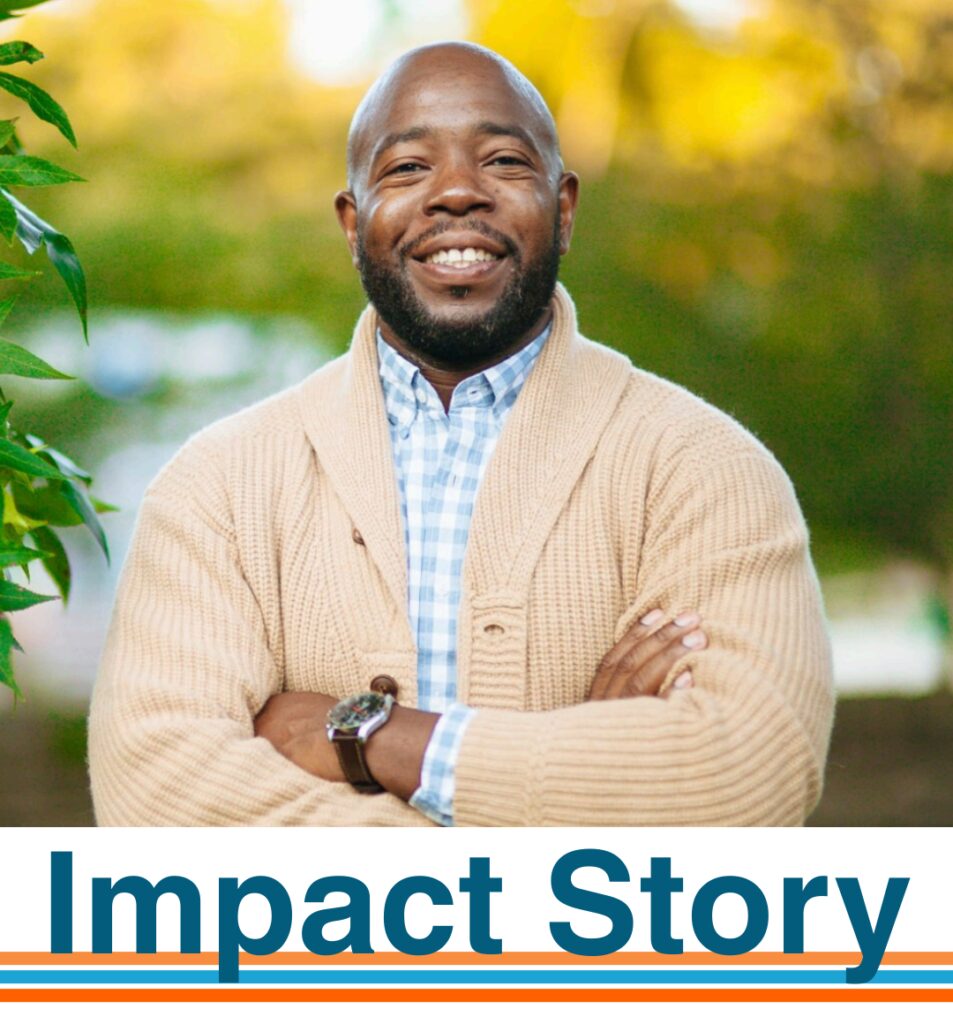
After 15 years in the banking industry, Barry Wilkins quit in search of a more fulfilling career. At the time, he didn’t imagine he’d dedicate his life to teaching. Instead, he took a consulting job with the City of Philadelphia. It was there he learned about opportunities in urban education, inspiring him to become a math teacher. “It was the hardest job I’ve ever had,” Barry said. He was out of his depth, experiencing firsthand the challenges that plague the education system
“When you start a school year underresourced, students are never going to have everything they need, but your goals and objectives don’t change. How do you deliver on the promise of equality every day to them? When you know that there are resources children must have, but don’t? These are systemic issues; it’s never the children. They’re the most rewarding part of the work.”
After several years developing his classroom skills, Barry joined Feltonville School of Arts and Sciences as Assistant Principal. Feltonville enrolls primarily marginalized students, 97% of whom don’t identify as white, and has faced persistent attendance challenges among middle schoolers, which impacts classroom success. It is also a partner school of Philadelphia Academies, Inc. (PAI). Barry’s elevation to the leadership team at Feltonville coincided with the introduction of the Middle School Success Network (MSSN), a PAI initiative providing professional development, coaching, and data-driven intervention strategies.
He became Feltonville’s attendance coordinator and worked closely with Mychal Barr, PAI’s Manager of Middle School Programs. Initially, Mychal’s presence was understated. “Mychal sat in on our attendance, our Multi-Tiered Support-System (MTSS meetings), and saw how we analyze the data, and he would also sit in on our grade level team meetings, observing the dynamics in the
different grade levels,” Barry said. Once he understood the school’s operations, Mychal began coaching Barry. “Mychal did a good job coaching me on how to access the data, how to interpret the data, sharing it with the right people, and coming up with a plan.”
Barry then applied PAI’s data strategies to identify chronically late students who could benefit from additional support. “We try to do our best to be protective when we start to see trends in students; we try to come up with a holistic plan to bring them back,” he said. One cohort of students began checking in each morning with climate specialist Coach Garolyn Jones, who led restorative circles. “Once we pulled them aside and gave them a little bit more attention, their tardiness was dramatically reduced in the second half of the school year,” Barry noted.
A key part of Barry’s collaboration with PAI was creating a supportive environment. “We didn’t want to demonize them, we didn’t want the students to look at the interventions as penalties,” he explained. Many students eventually grew to enjoy sessions with Coach Jones, whose experience coaching football and working with young people made her relatable and effective.
To build a positive school culture, Barry established incentives for attendance, including pizza parties for classes with high participation and awards for punctual students. He also personally greeted students each morning, promoting direct relationships beyond his role as assistant principal. “It’s about letting students know that we care about their attendance, we care about their health, we care about their future,” he said.
“In a short amount of time, around a month, our attendance target has improved by 30%,” Barry noted. This progress was remarkable, considering the partnership with PAI was still in its early stages. A fully dedicated team didn’t form until midyear, yet Barry emphasizes the importance of focused collaboration. “Having a team that really leverages the data so that there’s a focus is crucial, and working with PAI is like having an accountability partner,” he said. “That’s something PAI is really good about, finding
that low-hanging fruit. It doesn’t have to be a change to the whole system.”
The MSSN continues to evolve from the 9th Grade Success Network, a model supporting first-year high school students through data-driven interventions. Barry is already planning for next year, exploring new ways to engage both students and staff while using insights from the past year. “It might sound counterintuitive, but kids respond well to interventions through structure and consistency. They might hem and haw about it, but at the end of the day, they want to know what to expect.”
Barry’s journey from banking to education underscores his commitment to Philadelphia’s youth and his belief in the transformative power of support, data, and relationships. Through his collaboration with PAI, he has helped cultivate a school culture where students are held accountable yet genuinely supported, proving that meaningful change is possible even in a system facing persistent challenges.